Best FPV Goggles for Drone Racing: How Should Bulk Buyers Choose?
The best FPV goggles for drone racing can be difficult to identify when suppliers emphasize resolution, features, and premium pricing. That confusion becomes expensive when goggles prove incompatible or inconsistent across a fleet. I recommend starting with the video ecosystem, racing priorities, deployment scale, budget, and required delivery date.
The best FPV goggles for drone racing are the goggles that match the existing video-transmission system while providing suitable end-to-end latency, predictable link behavior, usable visibility, and stable fit. For bulk buyers, the right choice must also deliver consistent quality, maintainable hardware, replacement-part availability, and dependable supply within the project budget and timeline.
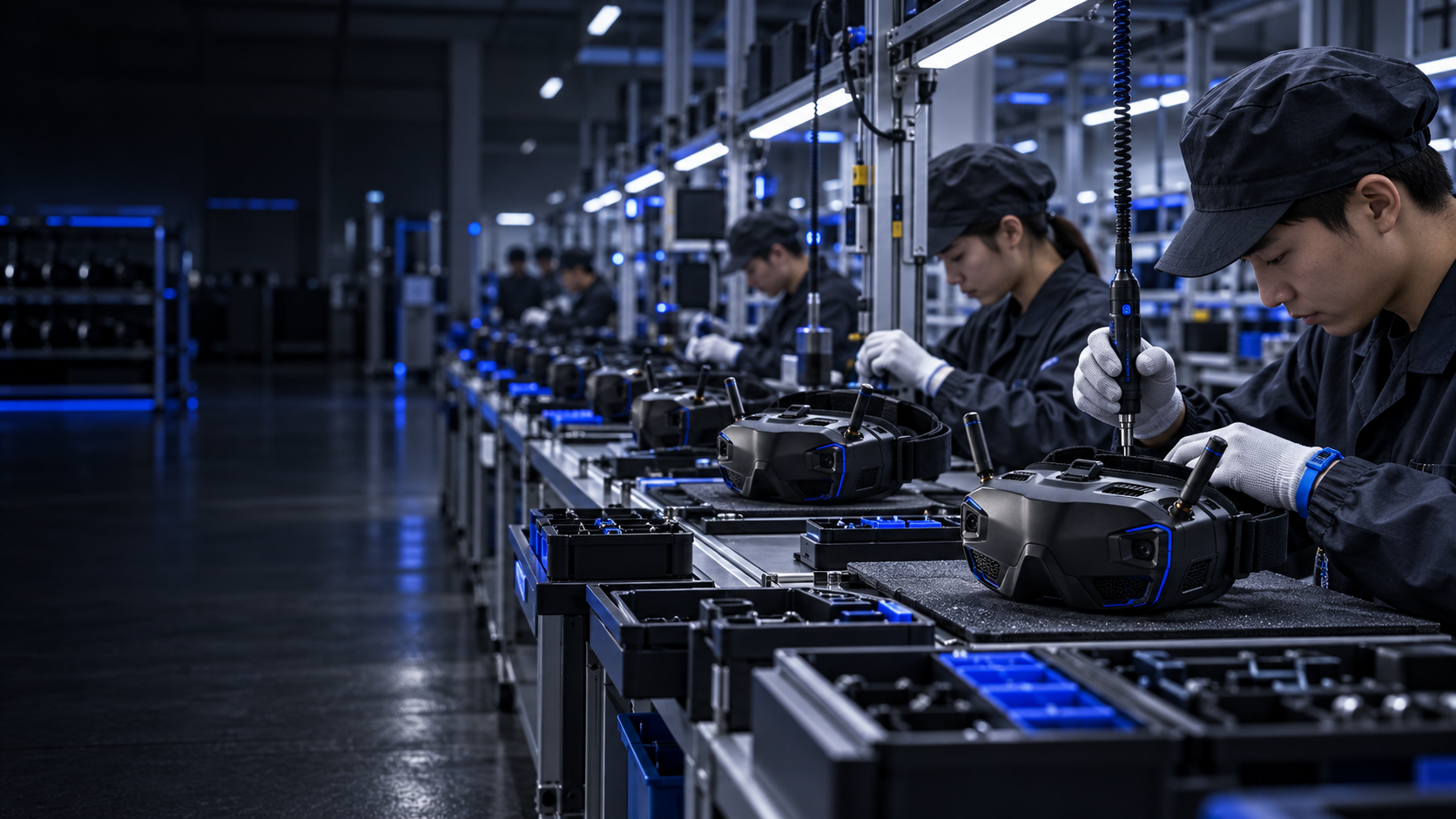
I do not treat “best” as a universal product ranking. A model that works well for one pilot can create compatibility, maintenance, or supply problems for a racing team. In this guide, I explain how I turn broad product comparisons into a practical procurement brief.
What Makes the Best FPV Goggles for Drone Racing?
FPV buyers often begin with screen resolution because it is easy to compare. However, a sharper display cannot solve delayed video, unstable signal behavior, poor fit, or incompatibility. I first define the racing task and then rank the specifications according to their effect on control and repeatability.
The best FPV goggles for drone racing combine compatible video reception, acceptable measured latency, predictable image behavior under signal stress, clear-enough displays, and a secure fit. I evaluate those factors as a system. I do not assume that the most expensive goggles or the model with the longest feature list will produce the best racing outcome.
I Use a Hierarchy of Racing Priorities
I usually organize the evaluation into four levels:
- Video-system compatibility
- End-to-end latency and link behavior
- Usable visual information and fit stability
- Secondary features and convenience
Compatibility comes first because an incompatible headset is not a candidate, regardless of its display quality. Latency and link behavior come next because racers need timely and predictable visual feedback1. Resolution matters, but I consider it within the wider context of optics, field of view, image processing, contrast, and signal conditions.
| Evaluation factor | Why I consider it important | Common procurement mistake |
|---|---|---|
| Video compatibility | Determines whether the goggles can receive the intended feed | Assuming all “digital” systems work together |
| End-to-end latency | Affects how quickly visual changes reach the pilot | Comparing unpublished headline figures |
| Link behavior | Determines how the image degrades or recovers | Testing only at close range |
| Optics and visibility | Affects how easily the pilot can read gates and obstacles | Selecting by panel resolution alone |
| Fit stability | Helps maintain a consistent viewing position | Using one wearer as the only fit reference |
| Power arrangement | Affects runtime and event operations | Ignoring battery logistics |
| Repairability | Influences downtime and lifecycle cost | Checking spare parts after deployment |
I Separate Necessary Performance From Premium Features
Features such as recording, wireless connectivity, head tracking, or advanced menus may support some applications. However, I do not automatically treat them as racing advantages. Extra processing can affect system behavior, while extra hardware can increase cost, weight, training requirements, and failure points.
In customer and team feedback available to us, recurring questions tend to concern compatibility, signal reliability, comfort, replacement parts, and delivery schedules. Buyers ask about resolution too, but it rarely resolves the entire decision. I use that pattern as procurement guidance, not as proof that one model performs best across the market.
I regard a specification sheet as the start of an investigation, not as evidence of racing performance.
When test data is required, I recommend comparing units under the same operating conditions. The report should identify the firmware, transmitter, camera, channel settings, recording method, distance, interference conditions, sample size, and latency definition. Without those details, two numbers may describe completely different tests.
How Does Compatibility Affect the Best FPV Goggles for Drone Racing?
A buyer can lose time by comparing displays before confirming the installed video system. Similar product language can hide closed ecosystems, optional modules, regional restrictions, or firmware dependencies. I therefore map every connected device before I recommend goggles for evaluation.
Compatibility determines whether the best FPV goggles for drone racing can operate with the buyer’s cameras, video transmitters, receivers, antennas, controllers, recorders, and power accessories. I verify both physical and protocol compatibility. I also check firmware support, channel availability, regional requirements, and any adapters needed for normal operation.
I Build a Compatibility Map
A useful compatibility review covers more than the name of the transmission technology. I ask buyers to document:
- Camera model and output format
- Video transmitter model and firmware
- Receiver or integrated receiver type
- Supported frequency bands and channels
- Antenna connectors and polarization
- Controller or head-tracking connections
- DVR output and recording requirements
- Battery voltage, connector, and expected runtime
- Regional radio and product-compliance requirements2
- Existing spare parts and field equipment
I also ask whether the buyer intends to maintain a mixed fleet. A mixed analog and digital environment may require different goggles, removable receiver modules, or a carefully validated adapter route. Each added interface creates another point that the procurement and technical teams must manage.
Analog and Digital Are Not Single Performance Categories
I avoid claims such as “analog is always faster” or “digital is always better.” Actual performance depends on the full implementation, including image capture, encoding, transmission, reception, decoding, display processing, and panel response3.
| Consideration | Analog implementations | Digital implementations |
|---|---|---|
| Image under worsening signal | Often develops increasing noise | May show artifacts, freezing, or abrupt loss4 |
| Detail potential | Usually limited by the full video chain | Can provide greater usable image detail |
| Latency behavior | Often relatively direct, but still system-specific | Can vary with processing and link conditions |
| Compatibility | May support modular receiver approaches | Often tied to a defined ecosystem |
| Fleet transition | Can suit established analog equipment | May require wider camera and transmitter changes |
| Evidence needed | Full-chain measurement | Full-chain measurement under several link states |
These descriptions are general tendencies, not model-level test conclusions. I would verify any supplier claim against the intended configuration.
I once reviewed a project discussion in which the goggle budget looked reasonable until the team listed the required transmitters, cameras, antennas, batteries, and spares. The complete system cost changed the decision. That experience reinforced a simple procurement rule for me: I compare ecosystem cost, not only headset price.
Which Performance Tests Identify the Best FPV Goggles for Drone Racing?
Published specifications may use different methods, and some do not define their test conditions at all. This makes direct comparisons unreliable. I prefer a documented, repeatable test plan that measures the complete video chain and includes more than one unit when the purchase is intended for a fleet.
I evaluate candidates for the best FPV goggles for drone racing through end-to-end latency testing, controlled link-degradation checks, visibility assessment, fit trials, power measurements, and unit-consistency inspection. Every result should state its method, configuration, sample count, environmental conditions, and limitations. Buyers should not compare latency numbers collected with different definitions or equipment.
I Define Latency Before Measuring It
“Latency” can refer to several different intervals. A camera-to-display measurement is not equivalent to a transmission-only measurement. I recommend defining the measurement points before the test begins.
A basic end-to-end method can use:
- A visible event shared by the source scene and a timing reference.
- The selected camera and transmitter configuration.
- The candidate goggles in their intended operating mode.
- A high-frame-rate recording that captures the source event and goggle display.
- Repeated measurements rather than one selected result.
- Reporting of the median, range, and sample count.
The test record should include:
- Camera, transmitter, receiver, and goggle model
- Firmware versions
- Resolution and frame-rate settings
- Channel and output-power settings
- Distance and antenna arrangement
- Recording frame rate and measurement uncertainty
- Number of runs and number of physical units
- Whether DVR, overlays, or other features were active
If the recording interval is coarse, the test has limited precision. For example, each frame at 1,000 frames per second represents one millisecond, while each frame at 240 frames per second represents about 4.17 milliseconds5. I would disclose that limit instead of reporting false precision.
I Test Link Behavior, Not Just Ideal-Range Latency
A bench test at short range does not show what happens near the edge of usable coverage. I also want controlled observations at several distances and signal conditions. The team can record:
- Image noise, blocking, or smearing
- Frame freezing or dropped updates
- Recovery time after obstruction
- Black-screen behavior
- On-screen warnings
- Changes in measured latency
- Pilot-readable detail under degradation
I treat subjective feedback separately from measured results. A pilot may report that one image feels more predictable, while instrumentation shows a particular latency distribution. Both inputs are useful, but they are not interchangeable.
Formal test capabilities can support this process, but the laboratory scope matters. A test performed on one unit cannot establish production-wide consistency. A controlled indoor result cannot guarantee outdoor radio performance. I recommend qualified RF, electrical, optical, safety, or human-factors evaluation when an application requires professional validation.
How Should Buyers Compare FPV Goggle Displays and Fit?
High-resolution panels attract attention because buyers can compare pixel counts quickly. However, optics can blur that advantage, and poor alignment can make the image uncomfortable6. A racing team also needs goggles that remain stable across movement and accommodate more than one face shape.
I compare display resolution alongside field of view, refresh behavior, optics, focus adjustment, interpupillary adjustment, contrast, brightness, edge clarity, and fit. The best racing headset provides usable visual information without creating avoidable strain or movement. I recommend structured wearer trials instead of selecting solely from panel specifications.
I Evaluate the Complete Viewing System
Panel resolution describes only one component. The wearer sees an image produced by the panel, lenses, housing geometry, adjustment range, and software processing. I therefore check:
- Center and edge clarity
- Readable detail in bright and dark areas
- Field-of-view consistency
- Interpupillary distance adjustment
- Focus or diopter adjustment
- Image distortion
- Refresh and motion behavior7
- Light leakage
- Fogging tendency
- Pressure distribution
- Strap stability
- Compatibility with corrective eyewear or inserts
I recommend using a repeatable visual target and the same video feed for each candidate. The evaluator should avoid changing multiple variables at once. If one goggle uses a different camera, transmission mode, or source file, the display comparison becomes less useful.
I Include Several Wearers in Fit Trials
A comfortable sample on one person may not fit an entire racing team. Head shape, interpupillary distance8, nose geometry, corrective-vision needs, and sensitivity to front-heavy equipment9 all vary.
A practical fit trial can ask each evaluator to score the following items on a consistent scale:
| Trial item | Example question |
|---|---|
| Initial comfort | Does the goggle create a pressure point within five minutes? |
| Stability | Does the image position shift during normal head movement? |
| Adjustment | Can the wearer reach a clear, aligned image? |
| Light control | Does external light enter around the face seal? |
| Heat and fogging10 | Does visibility change during an extended session? |
| Control access | Can the wearer find essential controls without removing the headset? |
| Cable management | Do power and accessory cables interfere with movement? |
I would test for a duration that reflects the intended deployment. A five-minute demonstration may not reveal heat, pressure, or battery-cable problems that appear during repeated training sessions.
Feedback from teams and customers has repeatedly shown me that small operational details become larger at scale. A difficult menu may be a minor inconvenience for one owner. It becomes a training and support issue when an operator needs to configure dozens of units before an event.
How Do Bulk Buyers Select the Best FPV Goggles for Drone Racing?
Individual reviews often focus on the experience of one unit. Bulk procurement introduces different risks. A team or training operator must receive consistent products, maintain them, replace damaged components, train users, and keep enough working units available throughout the program.
For bulk buyers, the best FPV goggles for drone racing must combine racing performance with production consistency, spare-part support, supply continuity, acceptable total cost, and realistic lead times. I recommend evaluating pilot samples and supplier processes before approving volume production. Buyers should also define inspection criteria, change-control rules, warranty procedures, and replacement plans.
I Review Fleet-Level Costs
The purchase price is only one part of the commercial decision. I calculate or estimate the total cost of ownership using:
- Goggles and receiver modules
- Cameras and video transmitters
- Antennas and cables
- Batteries and charging equipment
- Face pads, straps, and optical inserts
- Replacement displays or housings where available
- Freight, duties, and inspection
- Configuration and user training
- Warranty administration
- Downtime and spare-unit requirements
A lower-priced headset may cost more if it has inconsistent fit, unavailable parts, or a high replacement burden. A premium product may also be unjustified if its additional features do not support the racing task.
I Evaluate the Supplier as Well as the Sample
A strong sample does not prove that every delivered unit will match it. I ask suppliers how they control incoming materials, assembly, firmware, calibration, burn-in, final inspection, packaging, and traceability.
I also recommend confirming:
- Minimum order quantity
- Sample and tooling charges
- Production lead time
- Approved firmware version
- Critical component sources
- Golden-sample procedure11
- Incoming and outgoing quality criteria
- Acceptable quality limit12 or agreed inspection plan
- Spare-part availability
- Engineering-change notification
- Warranty and failure-analysis process
- Packaging and transport validation
Buyers should verify any certifications, declarations, or test reports provided by a supplier. A document should match the exact product model, configuration, manufacturer, standard, and intended market. I do not assume that a logo on a sales page proves compliance.
OEM or ODM development can make sense when a buyer needs specific branding, housing, accessories, firmware, packaging, or system integration. However, customization adds engineering validation, tooling, approval samples, and schedule risk. I recommend using a standard platform where possible and customizing only requirements that create clear operational or commercial value.
What Should an FPV Goggle Requirements Brief Include?
A vague request for the “best” goggles usually produces vague quotations. Suppliers may recommend different architectures, accessories, or quality levels, making their offers difficult to compare. I create a requirements brief that turns general preferences into measurable acceptance criteria.
A useful brief for the best FPV goggles for drone racing should define the video ecosystem, latency and link priorities, display and fit requirements, order quantity, target cost, compliance market, branding scope, quality plan, and delivery date. It should also distinguish mandatory requirements from preferences so suppliers can identify workable trade-offs.
I Start With Five Decision Questions
I ask every buyer to answer these questions:
- Which video ecosystem and connected equipment must the goggles support?
- Which performance factors matter most for the intended racing task?
- How many units are needed now and during the next 12 months?
- What is the target unit cost and total system budget?
- When must samples and production units arrive?
I then add measurable details. For example, “low latency” is too broad. The buyer should define the measurement method and acceptance threshold after qualified technical review. “Comfortable fit” should become a multi-wearer trial with an agreed scoring process. “Good range” should become a defined course, transmitter configuration, antenna arrangement, and acceptance condition.
I Separate Mandatory and Optional Requirements
| Category | Mandatory example | Optional example |
|---|---|---|
| Compatibility | Support for the installed video system | Support for a second legacy system |
| Performance | Agreed end-to-end latency test | Integrated recording |
| Optics | Required adjustment range | Premium lens coating |
| Operations | Replaceable face pad and strap | Custom carrying case |
| Branding | Logo and packaging artwork | Custom housing tooling |
| Quality | Approved golden sample | Additional cosmetic grade |
| Delivery | Units available before event date | Split shipment to several sites |
This structure helps me prevent feature creep. It also lets suppliers propose alternatives without hiding deviations.
The brief should request evidence in a consistent format. Supplier specifications, third-party reports, internal test results, and customer reports should remain clearly labeled. If comparable evidence is unavailable, I recommend arranging controlled sample evaluation rather than treating marketing claims as confirmed facts.
Frequently Asked Questions
Are digital goggles always the best FPV goggles for drone racing?
No. Digital goggles can offer detailed images, but performance depends on encoding, transmission, decoding, processing, firmware, and link conditions. Analog systems may suit established fleets or specific latency priorities. I recommend comparing the complete configured systems through the same documented test method.
How important is resolution when choosing racing goggles?
Resolution is important, but I do not use it as the deciding factor. Optics, field of view, refresh behavior, contrast, latency, link stability, and fit can have a greater effect on usable racing visibility. Buyers should evaluate the complete viewing and transmission chain.
How many samples should a bulk buyer test?
I recommend testing more than one unit whenever possible because a single sample cannot reveal production variation. The right sample size depends on order quantity, risk, and budget. A qualified quality professional can help create a sampling plan for pilot production and final inspection.
What documents should I verify before placing a bulk order?
I would verify model-specific specifications, test reports, declarations of conformity, quality records, warranty terms, and relevant certification documents. Buyers should confirm that each document applies to the exact manufacturer, hardware version, firmware, accessories, and destination market.
When does an OEM or ODM FPV goggle project make sense?
OEM or ODM development makes sense when standard products cannot meet necessary branding, integration, accessory, packaging, firmware, or mechanical requirements. I recommend comparing the value of customization against tooling cost, validation work, minimum order quantity, engineering risk, and lead time.
Conclusion
The best FPV goggles for drone racing are not automatically the highest-resolution or most expensive option. I first confirm video-system compatibility. I then compare end-to-end latency, link behavior, usable visibility, fit, and power needs through documented tests. For fleet deployment, I also evaluate production consistency, maintenance, spare parts, total cost, supplier controls, and delivery reliability. If your business needs racing goggles for bulk procurement, private labeling, or hardware integration, contact us with your existing video ecosystem, order quantity, target budget, technical priorities, and required delivery date so we can evaluate an appropriate OEM or ODM route.
"Nonlinear Performance Degradation of Vision-Based ...", https://arxiv.org/html/2603.06850v1. Human-in-the-loop teleoperation research indicates that visual latency exceeding 50–100 ms significantly degrades manual control precision and increases operator error rates. Evidence role: mechanism; source type: paper. Supports: System latency degrades human tracking accuracy and reaction speed in real-time teleoperation and remote vehicle control.. Scope note: Thresholds are derived from generalized robotic teleoperation and flight simulations rather than high-speed drone racing leagues specifically. ↩
"Advancing the spirit of amateur radio through innovation", https://www.itu.int/hub/2026/04/advancing-the-spirit-of-amateur-radio-through-innovation/. Regulatory authorities such as the FCC (under Title 47 CFR Part 15) and ETSI (under the Radio Equipment Directive) enforce strict radiated power limits and frequency allocations for unlicensed 5.8 GHz devices. Evidence role: definition; source type: government. Supports: Commercial wireless transmission in the 5.8 GHz band is subject to strict regional spectral masks, channel allocations, and equivalent isotropically radiated power (EIRP) limits.. Scope note: Regulations differ fundamentally between amateur radio license operations and unlicensed Part 15 consumer operations. ↩
"End-to-End Latency Measurement Methodology for ...", https://arxiv.org/html/2602.17381v1. Technical analyses of real-time vision pipelines divide end-to-end latency into sensor readout, frame formatting, codec buffering, radio packetization, and display scan-out stages. Evidence role: definition; source type: research. Supports: Glass-to-glass latency comprises sequential delays across capture, serialization, compression, channel propagation, decompression, and display refreshing.. ↩
"Cliff effect", https://en.wikipedia.org/wiki/Cliff_effect. In digital broadcast and communication systems, the 'cliff effect' describes the abrupt breakdown of decoded video reception when carrier-to-noise ratios drop below minimum receiver sensitivity thresholds. Evidence role: mechanism; source type: paper. Supports: Digital modulation schemes maintain full visual fidelity until bit error rates cross forward-error-correction thresholds, resulting in sudden frame freezes or signal drop.. Scope note: Specific cliff behavior varies significantly based on proprietary forward error correction and retransmission protocols. ↩
"End-to-End Latency Measurement Methodology for ...", https://arxiv.org/html/2602.17381v1. Standardized methods for measuring display latency via high-speed video establish that measurement resolution cannot exceed the camera's inter-frame exposure period (1/fps). Evidence role: general_support; source type: paper. Supports: Temporal sampling uncertainty in visual latency measurement is bounded by the interval between consecutive recording frames.. Scope note: High-speed video captures only temporal discrete events and may overlook rolling-shutter display artifacts. ↩
"Vergence–accommodation conflicts hinder visual ... - PMC - NIH", https://pmc.ncbi.nlm.nih.gov/articles/PMC2879326/. Vision science research demonstrates that improper optical axis alignment in head-mounted displays induces vergence-accommodation conflict and ocular muscle strain, leading to headache and fatigue. Evidence role: mechanism; source type: paper. Supports: Optical decentration and binocular disparity errors in near-eye displays induce visual fatigue, asthenopia, and disorientation.. ↩
"Vertical dynamic visual acuity is significantly lower than ... - PMC", https://pmc.ncbi.nlm.nih.gov/articles/PMC10684582/. Studies on dynamic visual acuity show that high refresh rates combined with low-persistence illumination improve target acquisition and reduce perceived blur in fast-moving synthetic imagery. Evidence role: general_support; source type: paper. Supports: Higher refresh rates and reduced pixel persistence mitigate hold-type motion blur and improve spatial visual tracking under fast angular velocities.. Scope note: Research primarily measures synthetic desktop or VR environments rather than analog/digital composite drone feeds. ↩
"Normal Interpupillary Distance Values in an Iranian Population", https://pmc.ncbi.nlm.nih.gov/articles/PMC3520592/. Anthropometric surveys of human interpupillary distance establish that adult binocular spacing typically spans from roughly 52 mm to 74 mm across diverse populations, requiring broad optical adjustment in head-mounted optics. Evidence role: statistic; source type: paper. Supports: Adult human interpupillary distance varies substantially across demographics, typically spanning roughly 50 mm to 75 mm.. Scope note: General population distributions include broad outliers that exceed standard commercial goggle adjustment mechanisms. ↩
"The Effect of Head Loading on Cervical Spine in Manual ...", https://pmc.ncbi.nlm.nih.gov/articles/PMC7904483/. Biomechanical evaluations of head-worn equipment indicate that forward center-of-mass shifts disproportionately amplify neck muscle load and cervical spine torque relative to total mass alone. Evidence role: mechanism; source type: paper. Supports: Anterior displacement of head-worn mass increases the gravitational moment on cervical extensor muscles, accelerating physical fatigue.. ↩
"Head-Worn Displays for NextGen", https://ntrs.nasa.gov/api/citations/20110011184/downloads/20110011184.pdf. Ergonomic research on facial interfaces shows that skin transpiration rapidly increases internal relative humidity, causing lens condensation unless convective ventilation maintains temperatures above the dew point. Evidence role: mechanism; source type: paper. Supports: Trapped ocular microclimate moisture condenses on cooler lens surfaces when internal humidity reaches the local dew point.. Scope note: The exact rate of fogging depends heavily on ambient environmental temperature and individual perspiration rates. ↩
"Technical Processes | www.waru.edu", https://www.waru.edu/tools/dau-systems-engineering-brainbook/technical-processes. In manufacturing quality engineering, a golden unit or reference sample represents an explicitly validated production specimen used as the physical tolerance baseline for subsequent inspection cycles. Evidence role: definition; source type: encyclopedia. Supports: A golden sample functions as an approved physical benchmark against which subsequent production units are calibrated and inspected.. Scope note: Golden samples can experience physical degradation or calibration drift over extended production timelines if not periodically reverified. ↩
"ISO 2859-1", https://chemistry.unt.edu/~tgolden/courses/iso2859-1.pdf. International standard ISO 2859-1 (and its domestic counterpart ANSI/ASQ Z1.4) establishes sampling schemes and Acceptable Quality Limit thresholds for lot-by-lot inspection by attributes. Evidence role: definition; source type: institution. Supports: Industrial inspection by attributes relies on standardized AQL sampling tables to define maximum tolerable defect rates per batch.. ↩